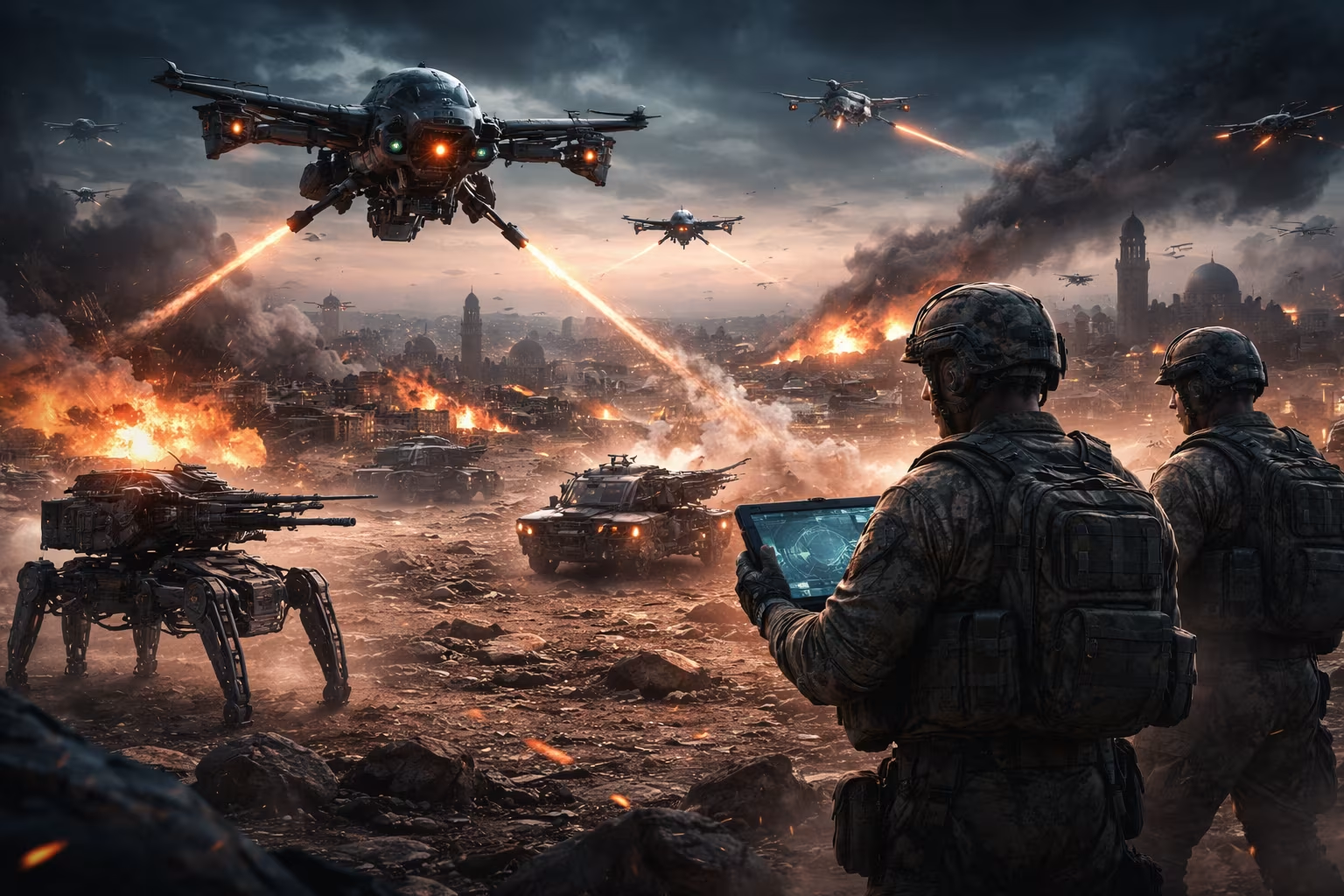
We're watching the future of warfare unfold in real-time, and it's not the sci-fi fantasy we thought it would be. Artificial intelligence is quietly reshaping modern conflict, and the ongoing tensions involving Iran have become a stark demonstration of how AI has crept into military operations faster than most of us realised. According to recent analysis from Chatham House, this isn't some distant threat—it's happening now, and it's accelerating at an alarming pace.
The Background: How We Got Here
Let's be clear about something: military AI isn't new. What's new is how sophisticated, accessible, and integrated it's become. For decades, militaries have used computer systems for logistics, communications, and basic automation. But the AI we're seeing deployed today is fundamentally different—it's making decisions, identifying targets, and executing actions with minimal human oversight.
The roots of this transformation go back to the early 2000s when the US military began seriously investing in unmanned systems. The Iraq and Afghanistan conflicts served as testing grounds for drone technology, but those early systems were essentially remote-controlled aircraft with human operators making every critical decision.
What changed was the convergence of several technologies: machine learning algorithms became more sophisticated, computer processing power increased exponentially, and sensor technology—cameras, radar, thermal imaging—became incredibly precise and affordable. Suddenly, systems could not just follow orders but interpret complex environments and make tactical decisions.
The real catalyst was the commercial AI boom of the 2010s. Companies like Google, Microsoft, and countless startups developed AI capabilities that were immediately applicable to military use. Computer vision systems that could identify objects in photos became target recognition systems. Natural language processing that powered chatbots became intelligence analysis tools. The technology transfer was inevitable.
What's Actually Happening in the Iran Context
The Chatham House analysis highlights how the current Middle Eastern conflicts have become a showcase for military AI applications. We're seeing AI-powered surveillance systems that can monitor vast areas and automatically flag suspicious activities. Drone swarms that can coordinate attacks without human intervention. Intelligence systems that can process massive amounts of data to predict enemy movements.
Iran itself has been developing its own AI military capabilities, partly out of necessity due to international sanctions limiting access to conventional weapons systems. They've invested heavily in autonomous naval vessels, AI-guided missiles, and surveillance networks. It's a arms race, but instead of nuclear weapons, it's algorithms and machine learning models.
What's particularly concerning is how these systems are being deployed with increasingly limited human oversight. Traditional military doctrine required human authorisation for weapons deployment, but AI systems can now identify, track, and engage targets in timeframes that make human decision-making impractical.
The recent conflicts have also demonstrated how AI warfare isn't just about big military powers. Smaller nations and even non-state actors can access AI military technology through commercial channels or cyber theft. A terrorist organisation can potentially deploy AI-powered drones using commercially available components and open-source software.
The Broader Implications: What This Changes
This shift represents a fundamental change in how conflicts will be fought, and the implications are staggering. First, the speed of warfare is accelerating beyond human comprehension. When AI systems can identify threats and respond in milliseconds, traditional military strategies become obsolete.
Second, we're seeing the democratisation of advanced military capabilities. Countries that could never afford to develop sophisticated weapons systems can now deploy AI-powered alternatives at a fraction of the cost. This levels the playing field in dangerous ways—a small nation with good programmers can potentially challenge a military superpower.
Third, the accountability problem is massive. When an AI system makes a mistake and kills civilians, who's responsible? The programmer who wrote the code? The commanding officer who deployed it? The politician who authorised its use? We're creating weapons that can kill without clear chains of responsibility.
The economic implications are equally significant. Traditional defence contractors are scrambling to integrate AI capabilities, while tech companies find themselves reluctantly—or enthusiastically—becoming military suppliers. Google employees famously protested the company's involvement in military AI projects, but the pressure to participate in defence contracts is enormous.
My Take: A Developer's Perspective on Military AI
I've been working with AI and machine learning systems since the early days, and I can tell you this: these systems are nowhere near as reliable as military planners seem to think. I've seen AI models fail in spectacular ways over tiny changes in input data. I've debugged systems that worked perfectly in testing but completely broke when deployed in real-world conditions.
The idea that we're deploying these systems in life-or-death situations is frankly terrifying. Any developer who's worked on computer vision knows how easily these systems can be fooled. A few strategically placed stickers can make an AI system see a stop sign as a speed limit sign. What happens when adversaries start using similar techniques to confuse military AI?
But here's what really bothers me: the tech industry's complicity in this arms race. We've spent years talking about AI ethics and responsible development, but when military contracts come calling, those principles seem to evaporate. The same companies preaching about AI safety are building systems designed to kill people.
From a technical standpoint, the current AI systems being deployed are essentially sophisticated pattern recognition tools. They're excellent at identifying objects and following pre-programmed rules, but they lack genuine understanding or reasoning capabilities. We're giving weapons systems the intelligence of a very advanced search algorithm and calling it artificial intelligence.
The scariest part? The feedback loops. Every conflict becomes training data for the next generation of AI weapons. Every successful deployment validates the technology and encourages further development. We're creating systems that literally learn how to kill more effectively.
What We Can Do About It
First, we need proper international regulation of military AI, and we need it now. The current legal frameworks for warfare were designed for human combatants, not autonomous systems. We need new international laws that specifically address AI weapons, including requirements for human oversight and clear accountability chains.
Second, tech companies need to take responsibility for how their technology is used. Every major AI company should have clear policies about military applications and should be transparent about their involvement in defence projects. If Google can refuse to work on certain military projects, other companies can do the same.
Third, we need better public understanding of what military AI actually is and isn't. The media often portrays AI weapons as either science fiction fantasies or inevitable technological progress. The reality is more mundane and more dangerous—these are powerful but flawed systems being deployed in situations where mistakes cost lives.
For developers specifically: be conscious of how your work might be used. That computer vision model you're training could end up identifying targets for weapons systems. That natural language processing algorithm could be used to analyse intercepted communications. Ask questions about how your technology will be deployed.
Investors and business leaders need to consider the ethical implications of funding AI military applications. There's plenty of money to be made in AI without building better ways to kill people. The commercial applications for AI are enormous—healthcare, education, climate change, transportation. We don't need to militarise every technological advance.
The Hard Truth About Our AI Future
The Iran conflict is just the beginning. We're witnessing the birth of algorithmic warfare, where software makes life-and-death decisions at machine speed. This isn't some dystopian future—it's happening right now, and it's accelerating.
The real tragedy is that we had a choice. We could have developed AI as a tool for human flourishing—for solving climate change, curing diseases, exploring space. Instead, we're using it to build more efficient ways to kill each other. Every line of code written for military AI is a line of code not written for something that could actually help humanity.
The question isn't whether AI will transform warfare—it already has. The question is whether we'll develop it responsibly or stumble blindly into an algorithmic arms race that makes the Cold War look quaint. Based on what we're seeing in conflicts like Iran's, I'm not optimistic. But maybe, just maybe, recognising the problem is the first step towards solving it.