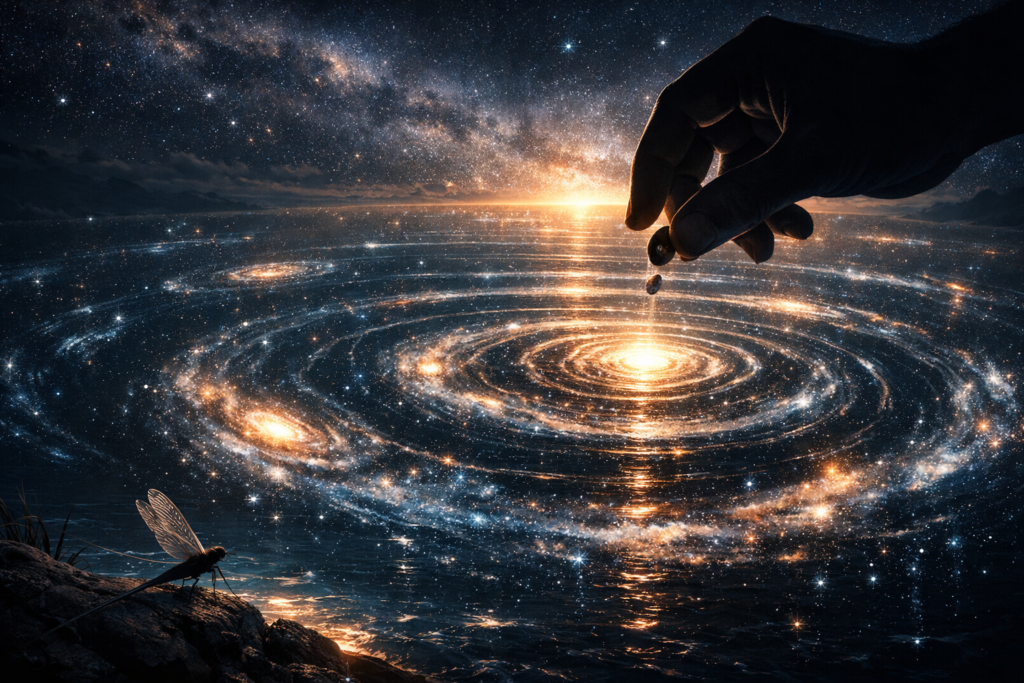
Life on Jupiter and Saturn’s Moons: Could There Be Solar Systems Within Our Solar System?
For decades, the search for extraterrestrial life focused almost entirely on planets orbiting stars, especially Earth-like worlds in the so-called "habitable zone." But modern planetary science has radically shifted that view. Today, many scientists believe that some of the most promising places to find life are not planets at all—but moons orbiting giant planets like Jupiter and Saturn.
These gas giants may not shine like the Sun, but through gravity, tidal forces, and internal heating, they create environments that resemble mini solar systems inside our own solar system. In this article, we explore how Jupiter and Saturn act as life-enabling hubs, why their moons are prime candidates for alien life, and how this idea is reshaping our understanding of habitability in the universe.
Why Gas Giants Matter in the Search for Life
At first glance, Jupiter and Saturn seem like unlikely players in the search for life. They are massive balls of gas with crushing pressures, toxic atmospheres, and no solid surface. Life as we know it cannot survive there. However, their importance lies not in the planets themselves, but in the powerful gravitational influence they exert on their moons.
Jupiter and Saturn act as gravitational engines. Their immense mass constantly stretches and compresses nearby moons, generating internal heat through a process known as tidal heating. This heat can melt ice, drive geological activity, and maintain vast subsurface oceans—key ingredients for life.
In effect, these gas giants replace sunlight with gravity as the primary energy source, allowing entire ecosystems to potentially exist far from the warmth of the Sun.
Jupiter: A Mini Solar System of Ocean Worlds
Jupiter is the largest planet in our solar system and hosts dozens of moons. Among them are four large worlds—Io, Europa, Ganymede, and Callisto—that are more like planets than typical moons. Each has its own geology, history, and potential for life.
Europa: The Most Promising Ocean World
Europa is widely considered one of the best places to search for life beyond Earth. Beneath its icy crust lies a global ocean of salty liquid water, possibly containing more water than all of Earth's oceans combined.
Cracks in Europa's surface suggest constant movement, while observations indicate water plumes may be erupting into space. The ocean is kept warm by tidal heating caused by Jupiter's gravity, and the seafloor may host hydrothermal vents similar to those on Earth.
On Earth, hydrothermal vents support rich ecosystems without sunlight. Instead, life relies on chemical energy—a process called chemosynthesis. If similar conditions exist on Europa, microbial life could thrive there today.
Ganymede: A Moon with Its Own Magnetic Field
Ganymede is the largest moon in the solar system—larger than the planet Mercury—and the only known moon with its own magnetic field. This magnetic shield may help protect its subsurface ocean from harmful radiation.
Evidence suggests Ganymede contains multiple layers of underground oceans sandwiched between ice. While this layered structure may limit chemical mixing, it also provides long-term stability, potentially allowing life to evolve slowly over billions of years.
Callisto: Quiet, Ancient, and Stable
Callisto is heavily cratered and geologically inactive compared to Europa or Ganymede. For a long time, this made it seem uninteresting. However, scientists now believe Callisto also harbors a subsurface ocean.
Because Callisto experiences less radiation and tidal stress, it may offer one of the most stable environments in the outer solar system—ideal for long-term habitability and even future human exploration.
Saturn: A Gentler but Equally Powerful Life Engine
Saturn is often seen as Jupiter's quieter sibling, but its moon system may be just as exciting—if not more so—when it comes to life.
Enceladus: An Ocean World Revealing Itself
Enceladus shocked scientists when geysers of water vapor, ice particles, and organic molecules were discovered erupting from its south pole. These plumes originate from a global subsurface ocean beneath an icy shell.
What makes Enceladus extraordinary is that we can sample its ocean without drilling through kilometers of ice. Spacecraft flying through the plumes have already detected organic compounds, salts, and molecular hydrogen—strong indicators of hydrothermal activity.
This combination of liquid water, chemical energy, and organic molecules checks nearly every box for habitability. If microbial life exists anywhere close to home, Enceladus is a top contender.
Titan: A World of Alien Chemistry
Titan is unlike any other moon in the solar system. It has a thick nitrogen-rich atmosphere, weather systems, and stable lakes and rivers—but instead of water, they are made of liquid methane and ethane.
Titan's surface chemistry is incredibly complex. Organic molecules rain from the sky, collect on the ground, and may interact with a subsurface water ocean deep below the ice.
Life on Titan, if it exists, would be radically different from Earth life. It could use methane as a solvent instead of water and operate at temperatures far below freezing. This challenges our assumptions about what life can be.
Life Without Sunlight: Redefining Habitability
One of the most important lessons from studying Jupiter and Saturn's moons is that sunlight is not a requirement for life. On Earth, entire ecosystems exist in total darkness, powered by chemical energy from the planet's interior.
These discoveries expand the definition of the "habitable zone." Instead of being limited to a narrow ring around a star, habitable environments may exist anywhere there is:
- Liquid water
- A steady energy source
- Complex chemistry
- Long-term stability
Gas giants provide all of these conditions to their moons, making them potential cradles of life across the galaxy.
Solar Systems Within Solar Systems
When viewed through this lens, Jupiter and Saturn truly resemble miniature solar systems. Each moon is a world with its own environment, internal heat, and evolutionary path, all orbiting a central gravitational powerhouse.
This concept has profound implications beyond our own solar system. Many exoplanets discovered so far are gas giants. If they host moon systems similar to Jupiter and Saturn, then habitable worlds may be far more common than Earth-like planets.
Some scientists even believe that ocean moons could outnumber Earth-like planets by a large margin, making them the most common habitats for life in the universe.
What This Means for the Future
Upcoming missions will further explore these ocean worlds, searching for biosignatures, organic chemistry, and signs of active ecosystems. Instead of asking whether Mars once had life, we are now asking whether entire hidden oceans are alive right now.
The idea that Jupiter and Saturn host solar systems within our own solar system is no longer science fiction—it is a scientific framework guiding real exploration.
If life is discovered beneath the ice of a distant moon, it will fundamentally change how humanity sees its place in the universe. Earth may not be unique. Life may be a natural consequence of energy and chemistry wherever they arise—even in the cold, dark outskirts of a planetary system.
Conclusion
Jupiter and Saturn may never shine like stars, but through gravity and time, they create worlds where life could exist. Their moons represent some of the most compelling targets in the search for extraterrestrial life and redefine what it means for a world to be habitable.
In the quiet darkness beneath icy shells, entire oceans may be alive—proof that even within our own solar system, we may not be alone.