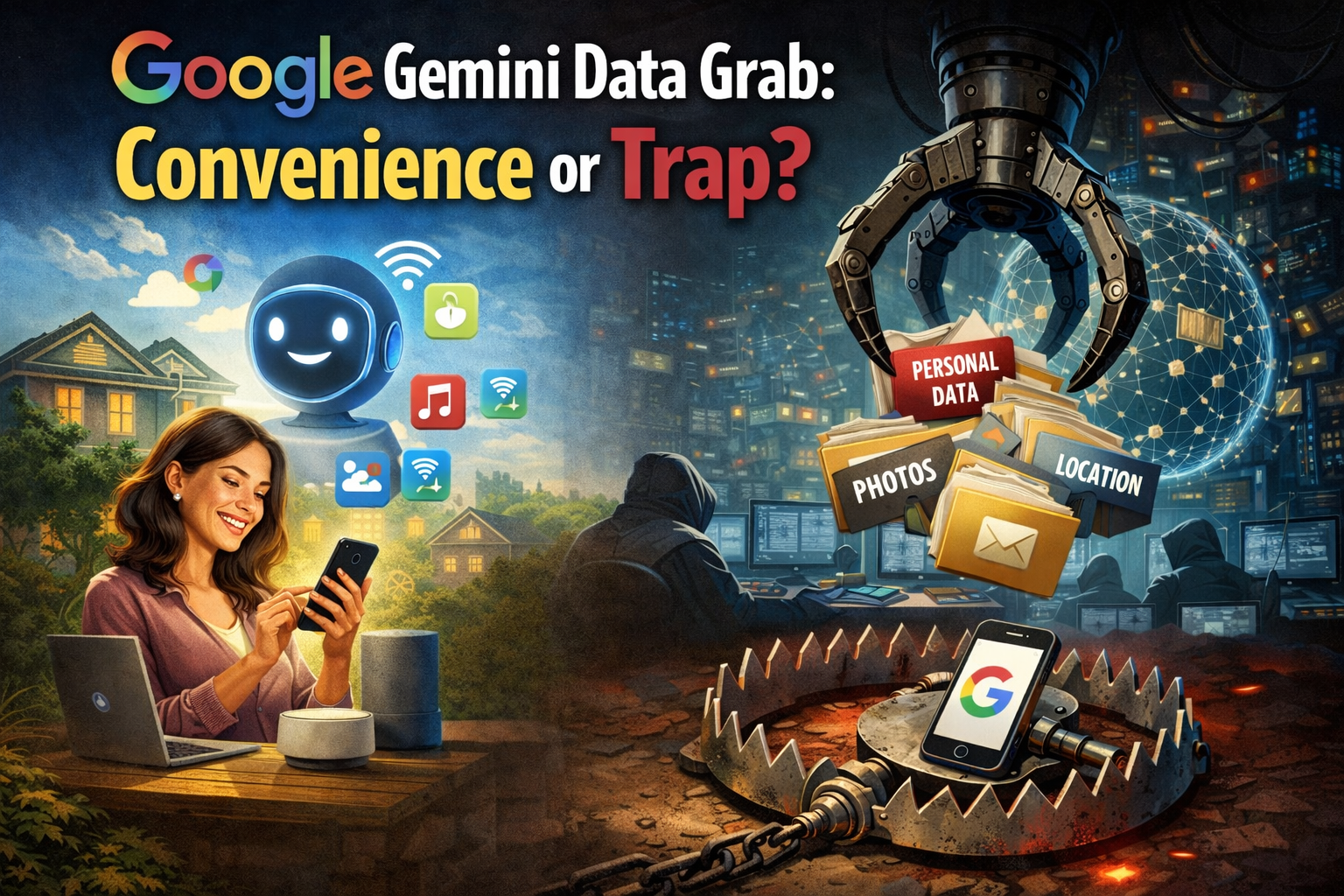
Let's be blunt. Google's latest move—letting you import your chat history and 'memories' from other AI assistants into Gemini—isn't about you. It's about them. It's a masterstroke of ecosystem lock-in disguised as user empowerment, and if you've been online since the early 2000s like I have, you'll recognise the pattern immediately. They're not building a better AI; they're building a moat, and your conversational history is the mud they're using to line it.
The Long Road to This Announcement
To understand why this matters, you have to remember Google's tortured AI history. This is the company that famously declared 'AI first' but then fumbled the bag with a series of public, embarrassing missteps. We had Bard, the clunky, factually suspect chatbot that launched with a disastrous demo. We had the awkward rebrand to Gemini, a name that feels less like a product and more like a placeholder. And throughout, there's been the ever-present shadow of OpenAI's ChatGPT, which captured the public's imagination and made Google look like a lumbering giant asleep at the wheel.
The context is simple: user retention. People were having meaningful, useful, sometimes deeply personal conversations with ChatGPT. They were building a history, a context, a workflow. Google's Gemini, for all its technical prowess on the backend, was a blank slate. Starting from zero every time is a terrible user experience. So, faced with the reality that their AI was a ghost town, they've decided the quickest way to populate it is to invite the residents of a rival town to move in, baggage and all.
The Announcement in Plain English
The blog post from Google (linked in the source) is written in that familiar, breathless corporate tone of 'we're doing this for you!' But strip away the fluff: Google is introducing a tool that allows you to export your chat data from other AI services—presumably primarily ChatGPT—and import it directly into your Google Account's Gemini history. This includes the text of your conversations and any 'memories' or custom instructions you've set. It's a data migration tool for your AI persona.
Technically, this is a non-trivial feat. It means building parsers for another service's data format (likely using the OpenAI API export format), mapping it to Google's internal schema, and then integrating it seamlessly into the Gemini UI so it feels like you never left. It's a significant engineering investment, which tells you how desperately they want that data.
What This Actually Changes
On the surface, it's a win for the user. You don't lose your context. You can switch AI assistants without feeling like you're starting a new job with no memory of your last one. But the implications are vast and deeply strategic.
The Immediate Benefits (The Carrot)
- Continuity of Experience: Your project context, your coding snippets, your brainstorming sessions—they come with you. This reduces the friction of trying a new platform.
- Workspace Integration: This is the big one. By getting your history into Gemini, Google can now hyper-personalise its integrations with Gmail, Docs, Drive, and Calendar. Imagine an AI that not only remembers you wanted to write a blog post last week but can now scan your Drafts folder for related notes. The potential utility skyrockets.
- Breaking the Habit: ChatGPT has become a verb. It's the default. This move is a direct assault on that habit. They're lowering the barrier to entry to 'try us' by removing the biggest pain point: the cold start.
The Deeper Strategic Play (The Stick)
- The Data Moat Deepens: Your chat history is a goldmine for training better models. By aggregating this high-quality, user-curated conversational data, Google accelerates its own model development in a way that is uniquely tailored to the tasks its users actually care about. They're not just getting your data; they're getting a refined, annotated dataset.
- Ecosystem Lock-In, Version 2.0: First, they locked you in with Gmail and Search. Then with Android and Photos. Now they're locking you into your AI identity. The more history you build in Gemini, the more invested you are in the Google ecosystem. Leaving isn't just losing an email account; it's losing years of contextual AI assistance. The switching cost becomes existential.
- Neutralising the Competition: This is a direct attack on OpenAI's user base. They're not competing on raw capability alone (though Gemini is excellent); they're competing on convenience and integration. They're leveraging their existing monopoly in workspace software to win the AI war.
Who Wins, Who Loses?
The winners are clear. Google wins by gobbling up user history and cementing its ecosystem. Power users who live in Google Workspace win by getting a more contextual, integrated AI assistant. Newcomers to AI might win by getting a tool that already has a semblance of a memory out of the box.
The losers are more subtle. OpenAI and Anthropic lose a key differentiator—their established user history and the sticky habits that come with it. Privacy-centric users lose, as this centralises even more of your digital footprint under one corporate roof. And the open AI ecosystem loses. This move incentivises a walled-garden approach. Why build interoperable standards when you can just import your rival's data directly? It stifles the potential for a true, multi-model, federated AI future.
My Take: A Developer’s Skepticism Since 2004
I've been building for the web since the dial-up days. I've seen Google announce and then kill more products than I can count: Reader, iGoogle, Hangouts, Stadia. Their corporate strategy is a graveyard of abandoned services. So when they promise you a seamless future with your AI 'memories,' my immediate reaction is: what's the catch? What happens when they decide Gemini+ is the new thing and deprecate the current version? Where does your imported history go?
The language of 'memories' is also powerfully misleading. An AI doesn't remember. It retrieves patterns from a statistical model. It has no consciousness, no continuity of self. By framing it as 'memories,' Google is anthropomorphising the technology to make the data feel more personal, more valuable, and therefore more traumatic to lose. It's a psychological lock-in technique.
Furthermore, the technical implementation will almost certainly be one-way. You can import your ChatGPT history into Gemini, but I'd bet my next royalty cheque there's no easy, official way to get it out again in a usable format. This is the classic data trap: easy in, nearly impossible out. They're not giving you a portable identity; they're giving you a one-way ticket to their city.
What You Should Actually Do
Don't just mindlessly click 'import.' Think like a strategist.
- Audit Your History First: Use OpenAI's export tools (in your account settings) to get a full JSON dump of your chats. Read it. What's in there? Personal medical queries? Business strategies? Private messages? Knowing what you're about to migrate is crucial.
- Ask Why You're Moving: Is it for the Google Workspace integration? That's a valid, powerful reason. Is it just because it's new? That's a bad reason. Have a concrete goal.
- Consider the Privacy Trade-Off: You are about to feed your entire AI conversation history—a rich profile of your thoughts, projects, and mistakes—into Google's advertising and profiling machine. They already know what you search. Now they'll know what you think about, how you solve problems, and what you create. Is that worth the convenience?
- Use a Staging Account: If you must try it, do it with a throwaway Google account first. Import a subset of your data. See how it feels, how it's presented, what new features it unlocks. Don't put your primary history in until you're sure.
- Keep Your Export: That JSON file you downloaded? Keep it. Safely. Forever. It's your only guaranteed, platform-agnostic copy of your work. Treat it like a backup of your diary.
- Explore Alternatives: Look into local, open-source models (via Ollama, LM Studio) where your data never leaves your machine. Or privacy-focused services like Claude (Anthropic) or Perplexity. The goal isn't to be a Google or OpenAI user; the goal is to be an informed user who owns their own data.
The Final Word
Google's 'gift' of data portability is a Trojan Horse. It's a brilliant, cynical, and utterly predictable move from a company that has always prioritised ecosystem dominance over user sovereignty. They're betting that the siren song of convenience and integration is louder than the quiet alarm bells of data consolidation. And for most people, they're probably right.
But for those of us who remember the web before it became a series of walled gardens, this feels like another step towards a future where your digital life—including your AI-augmented thoughts—is owned by a handful of corporations. The question isn't whether you should bring your memories to Gemini. The question is: at what point do we, as users and developers, start demanding true data portability and the right to be forgotten by these systems? Because right now, they're only offering us one half of that deal.