The UK education system is broken. Not just cracked around the edges—fundamentally broken. While we've been tweaking GCSE syllabuses and arguing over EBacc requirements, the world has moved on. AI is reshaping the job market faster than we can update textbooks, students are drowning in irrelevant content, and we're still operating on a school schedule designed for the Industrial Revolution. It's time for radical reform.
The Job Market Has Changed. Education Hasn’t.
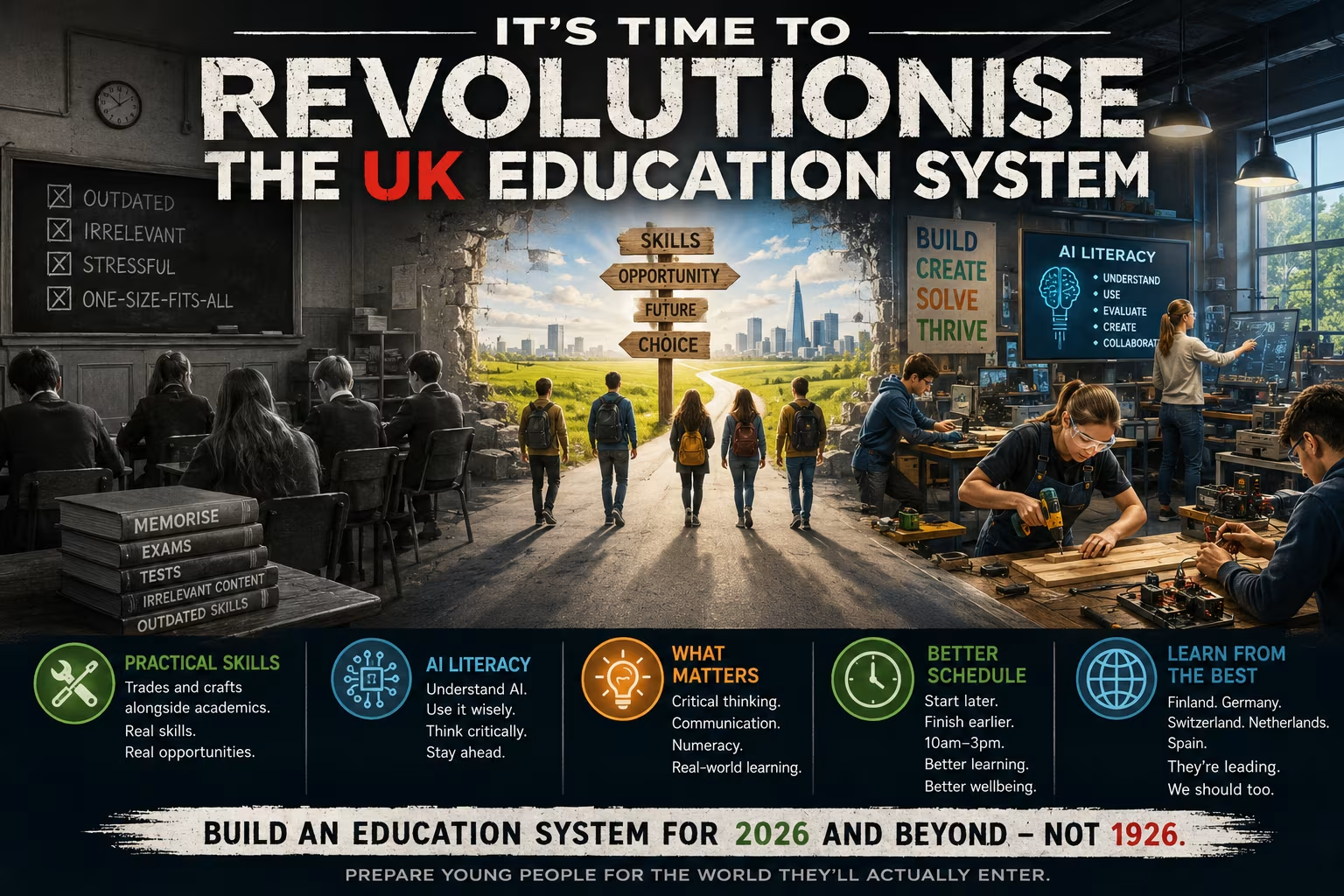
Let's face facts: thousands of students are studying for careers that won't exist by the time they graduate. They pour years into subjects designed to tick boxes, pass exams, and secure qualifications that are supposed to guarantee opportunity. Except they don't. They leave school with nearly identical grades and qualifications, all chasing the same dwindling pool of jobs.
The irony? Meanwhile, plumbers, electricians, carpenters, and skilled tradespeople are in desperate demand. We've created a culture where academic qualifications are king and practical skills are seen as second-class options. That's backwards.
AI is accelerating this problem. Roles in data entry, basic accounting, and administrative work are being automated. Even knowledge work—writing, analysis, coding basics—is increasingly being handled by AI systems. We're preparing students for a job market that's disappearing while ignoring roles that are actually hiring.
What Needs to Change
1. Embrace Practical Skills Alongside Academic Learning
Every student should have meaningful exposure to trades and crafts. Not as a consolation prize for those who "can't do academics," but as a core part of everyone's education:
- Building and construction – Understanding structures, materials, and design
- Plumbing and electrics – Essential practical knowledge
- Carpentry and joinery – Problem-solving through making
- Hospitality and food production – Real-world commerce skills
- Welding, mechanics, and metalwork – High-demand, well-paid careers
These aren't lesser subjects. They're the industries where young people can actually find employment, start businesses, and build secure futures.
2. Make AI and LLM Literacy Mandatory
If we're not teaching students to understand, use, and critically evaluate AI tools, we're setting them up to be left behind.
Every student should graduate with:
- Understanding of how LLMs and AI work (the basics)
- Practical experience using AI tools responsibly
- Skills to prompt, evaluate, and verify AI outputs
- Knowledge of AI's limitations and risks
- The ability to use AI as a collaborator, not a replacement for thinking
This isn't optional. This is digital literacy for 2026 and beyond.
3. Cut the Pointless Content, Keep What Matters
Not every student needs to memorize the periodic table or parse every Shakespeare sonnet. We're packing curricula with content that students forget weeks after exams.
Focus should be on:
- Critical thinking – How to evaluate information, solve problems, and adapt
- Communication – Writing, speaking, and presenting clearly
- Numeracy and data literacy – Real maths with real applications
- Core science – Understanding the world, not memorizing facts for exams
- Practical project-based learning – Real problems, real solutions
Make space for depth in areas students actually care about, rather than breadth in everything.
The Schedule Needs a Complete Rethink
Start Later, Finish Earlier
The current school day doesn't match how young people's brains work. Starting at 8 or 9am is fighting teenage biology. Students are exhausted, attention spans collapse, and we're blaming them for not being engaged.
This isn't a luxury—it's evidence-based. Later starts mean:
- Students arrive alert and ready to learn
- Better concentration and information retention
- Reduced mental health issues related to sleep deprivation
- Shorter day doesn't mean less learning; it means better quality learning
And other European countries are already proving this works.
What Other European Countries Are Already Doing
Finland: The Global Success Story
Finnish schools start between 8-9am and end between 1-3pm, depending on the student's age and schedule. Finnish students do the least number of class hours per week in the developed world, yet get the best results in the long term.
This isn't failing children. It's liberating them. Studies from the University of Helsinki found that students who start school later in the morning perform better academically, experience lower stress levels, and show improved mental health. Finnish schools have longer class periods and much longer breaks in between, creating an environment of holistic learning rather than "ram and cram" information.
Finnish students are not measured at all for the first six years of their education and only sit for a centralized exam (the National Matriculation Exam) at age 18-19. No constant testing. No comparison between schools. The result? Finnish students consistently rank high in international assessments, with the Programme for International Student Assessment (PISA) reporting that Finnish students outperform peers from countries with longer school hours.
Spain: Different Approach, Different Priorities
Spain's school hours vary, with some schools running from 9am to 5pm with a two-hour lunch break, while others run 9am to 2pm. The key difference from the UK? The extended lunch break reflects Spanish cultural values—families prioritize time together during the middle of the day, and the school structure supports that.
Spain's system shows there isn't one "right" model, but what matters is alignment with actual family and cultural needs, not outdated timetables.
Germany & Switzerland: The Vocational Gold Standard
While Northern Europe gets the headlines for academic success, Germany and Switzerland are quietly dominating in practical skills and youth employment.
In Switzerland, around two-thirds of young people learn a trade after compulsory schooling, with apprenticeship programmes beginning at age 15 and usually completed by 18 or 19. Apprentices spend around three to four days a week in the firm and the rest of the time in vocational school as well as inter-company vocational training.
The result? Switzerland has been one of the leading nations in world championships of vocational skills for decades, thanks to the Swiss vocational training system which ensures high-quality, practical and versatile basic training.
In Germany, children get the opportunity to try out different sectors and industries whilst at school through what Germans call "Schnupperpraktikum"—a "sniff placement"—which is vital in giving children time out from school to experience what it's like in the workplace.
The Netherlands: Balance and Mental Health First
The Netherlands builds its school system around students' needs and healthy life balance, prioritizing student happiness and teaching children how to think for themselves, while maintaining high academic standards. Schools put mental health first and keep the school day short, giving children more time for a balanced life outside the classroom.
Why Is the UK Different?
We're one of the few Western European nations still clinging to the old model. Long school days. Early start times that fight teenage biology. A rigid academic curriculum with nowhere to learn practical skills. Constant testing and comparison. We're exhausting our young people while other countries are thriving.
The evidence is everywhere. It's not hidden. The question is: why aren't we acting on it?
Summer Holidays Need Rethinking
Six weeks was designed for agricultural work. We're not there anymore. But current timing is even worse—breaking up late in July when the days are already shortening defeats the purpose entirely.
Better options:
- Longer summer break (7–8 weeks) – Give families proper time
- Earlier start to summer – Break up in late June while the weather is still good
- Scattered holidays instead of one long break – Three 2–3 week breaks throughout the year might work better for modern families
- Shorter half-term breaks – A week is better than a fortnight mid-year
The point: align the calendar with actual seasons and family needs, not outdated timetables.
The Bigger Picture
Education should prepare young people for the world they'll actually enter, not the world we wish existed. Right now, we're doing neither effectively.
We're asking 16-year-olds to choose their futures based on GCSE options. We're telling them that going to university for a 3-year degree in something they might not care about is the path to success. We're ignoring that one apprenticeship in a skilled trade might lead to a more secure, better-paid career than a bachelor's degree.
We're exhausting them with long school days and meaningless content while the skills they actually need—practical abilities, AI literacy, critical thinking, resilience—take a back seat to exam preparation.
Meanwhile, everywhere around us—in Finland, Spain, Germany, Switzerland, the Netherlands—countries are building better systems. They start school later. They finish earlier. They teach trades alongside academics. They value vocational pathways. They protect mental health. And they outperform us.
This has to change.
The businesses desperate to hire skilled workers, the parents watching their kids burn out, and the young people themselves all know the system is broken. The only people who seem unable to see it are the ones making policy.
Other countries have already shown us the blueprint. We just need the will to follow it.
It's time to build an education system for 2026 and beyond—not 1926.